





















































Weapons legislation (knives, axes)
Legislation
Since the change in the law on September 6, 2013, knives have been reclassified as Category D weapons, instead of their previous classification as Category 6 weapons.
Before September 6, 2013
According to Article 2 of Decree 95-589 of May 6, 1995 relating to the application of the Decree of April 18, 1939 establishing the regime of war materials, weapons and ammunition are 6th category weapons:
For clarity: French law says nothing at all about knives with blade locks, knives that open with one hand, or knives that open quickly. There are countries where this is the case, so be careful if you travel abroad.
"Paragraph 1:
All objects likely to constitute a weapon dangerous to public safety, including bayonets, sword bayonets, daggers, dagger knives, batons, canes, sword canes, leaded and iron-tipped canes, except those which are iron-tipped at only one end, crossbows, Japanese flails, throwing stars, knuckle dusters, competition slingshots, hypodermic projectors."
In addition to the national law regarding weapons, you must also consider local regulations. A knife that you can normally carry on your person may be prohibited by local regulations, for example, in entertainment venues or football stadiums. Even a screwdriver on a train to Paris may already be considered a prohibited weapon.
The acquisition and possession of Category 6 weapons is free when their purchaser or holder is over 18 years old. However, their carrying and transport are prohibited unless there is a legitimate or professional reason (police officer, security guard, etc.). The bearer of a Category 6 weapon can justify carrying this weapon when he has a license within an approved sports federation (in the context of practicing a martial art or combat sport for example). The carrying of this type of weapon is also permitted when justified by a professional reason. As such, representatives of the police or security guards may be authorized to carry, in the exercise or on the occasion of their duties, weapons of this category.
New classification of weapons
As of September 6, 2013, new legal measures stemming from the law of March 6, 2012, became effective. These amendments toughened criminal penalties for individuals committing weapons-related offenses and introduced a new classification. Weapons will now be classified into four categories:
- Category A for prohibited firearms (example: automatic weapons such as Kalashnikovs)
- Category B for firearms subject to authorization (example: semi-automatic or repeating revolvers)
- Category C for firearms subject to declaration (example: long firearms with a single shot per rifled barrel)
- Category D for other weapons, including shotguns, knives, batons, etc. (see the list of category D weapons set out in the new regulations)
Please note that while the purchase and possession of these weapons are free, the carrying and transport without legitimate reason of the following weapons , weapon components and ammunition are in principle prohibited .
Some clarifications
Transportation
If a Category D weapon is to be transported, there are different conditions
NB: Do not confuse carrying (on oneself) and transport (Vehicle, bag, briefcase).
- The weapon must not be 'directly' usable. This means it must be securely packed in a case or container, preferably with a padlock or other locking mechanism. Therefore, be careful when transporting it in backpacks.
- The 'bearer' must be able to provide a legitimate reason. A shooting license, an invitation to a collectors' fair, or a statement from an employer may provide legitimate reasons.
Concept of 'legitimate reason'
- The "legitimate reason" is verified on a case-by-case basis by law enforcement and the judge.
- In the event of an inspection, they decide, based on the elements observed and the situation, whether the legitimate reason is proven or not, according to the facts and the explanations presented by the holder.
It should be noted that it is this notion of "legitimate reason" for carrying or transporting the weapon which determines whether or not the offence exists (the typical reason "to defend oneself" or "just in case" are, of course, not valid reasons).
The assessment of the "legitimate reason" therefore depends on the circumstances and places as well as the context (public demonstration, public places such as discos, bars, stadiums).
Some examples
- A license issued by a sports federation is considered a legitimate transport permit for weapons used in the context of a sporting activity (from home to the training location or from home to the gun shop).
- Category 6 weapons transported in large numbers (this is often the case for collectors going to an exhibition) must be transported in such a way that they cannot be used immediately, either by using a technical device or by dismantling them. The collector must be able to prove that he is actually going to an exhibition.
- The case of the hunter or the fisherman (round trip), for hunting knives, daggers.
- The case of the worker who goes to or returns from his workplace.
Two special cases: Opinel and Laguiole
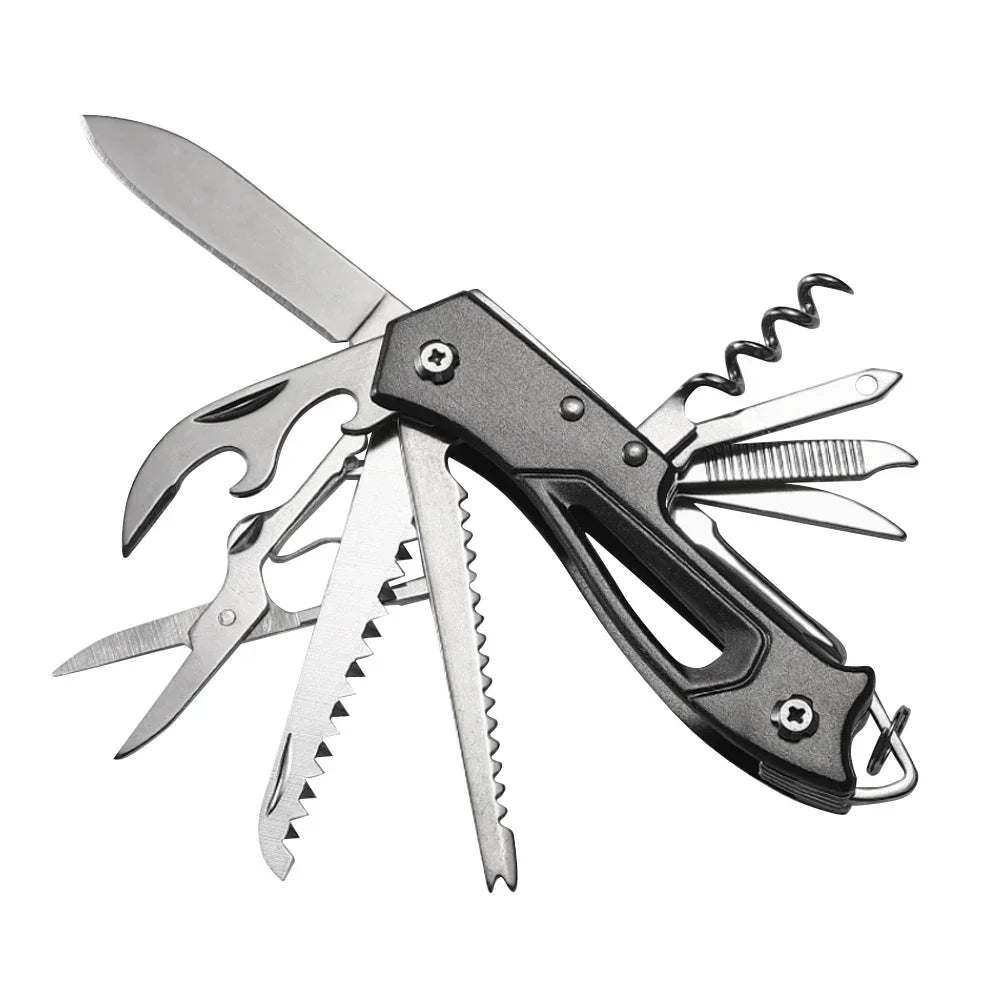
Opinel knives are equipped with a ferrule locking system, which classifies them as "dagger knives" by law. Their blade locking mechanism therefore makes them illegal to own or carry without a legitimate reason. However, many Laguiole knives do not have a blade locking system, exempting them from the "category 6 weapon" classification and allowing them to be carried without justification.
However, the legitimacy of carrying a knife will depend on the circumstances and the situation at the time of a check: a hiker will probably be able to keep their Opinel if they are stopped in the wilderness, while a passenger on public transport in a big city will have to explain why they are carrying their Laguiole. When it comes to carrying knives, it is important to exercise common sense and rationality. If in doubt, it is recommended to leave your knife at home.
Local regulations - attention
In addition to complying with national gun laws, it's essential to follow local regulations. For example, a knife that's legal for ordinary possession may be prohibited in certain places, such as entertainment venues or sports arenas. It's important to note that a simple screwdriver on a train ride to Paris could be considered a prohibited weapon.
Give up his knife?
If your knife is seized, you will often be asked to leave it. Keep in mind that abandoning it means you won't be able to get it back and it will usually be destroyed. It's not uncommon for a knife to be confiscated without valid reasons, often due to confusion over what is and isn't allowed. We recommend not giving your knife away immediately. While this doesn't guarantee it won't be seized, you can at least challenge the confiscation in court to try to get it back.
Source and information: https://www.service-public.fr/particuliers/vosdroits/N287


